

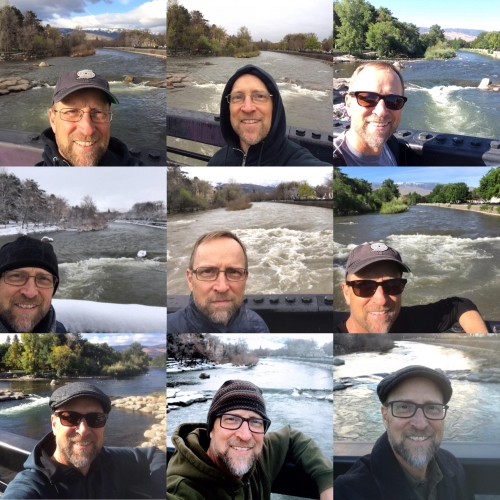
Anyone who knows me knows I love the Truckee River, 121 miles of dynamic natural beauty connecting Lake Tahoe, a treasure of the Sierra Nevada mountains, to Pyramid Lake, the biggest remnant of the colossal inland sea that once covered most of Nevada. While I could write pages about why I love this river, it mainly comes down to the way it makes me feel when I’m near it and what that does for my peace and presence of mind. The 9-photo collage here is made up of selfies of me in one of my favorite pots, standing on the footbridge connecting 1st St. in downtown Reno with Wingfield Park.
When I reach the middle of this bridge, usually with my two trusty canine companions, a feeling of settling and serenity come over me as I first gaze west upstream toward the Sierra Nevada, the perspective here in these photos, and then east toward downtown Reno, all the while breathing what to me seems like some of the freshest air anywhere. It’s from this vantage point that I literally commune with the Truckee, using all my senses to take stock of whatever state it happens to be in, whether flowing easily by on a warm summer’s day or surging near flood stage during or just after a warm winter storm. The photos here capture the river, and me, in a variety of conditions.
As for me, I appear to be happy in almost every one of these photos except for the center one from April 17, 2017 where my mood seems as roiling and cloudy as the water rushing by below me here during one of the Truckee’s high-water events. These were indeed difficult times with the stress of our twin boys’ impending high school graduations and college adventures. The truth is that while I look to be at ease in near all the photos, there are some in which I’m likely just smiling because I’m taking a picture of myself and am conditioned to smile for pictures.
And so, I show up to this spot above the Truckee on both good, bad and indifferent days, much in the same way I show up for my mediation practice, which isn’t the only parallel I draw between these two activities. When providing meditation instruction, I often use the analogy of a river to represent what at times is an easy-flowing stream of thoughts meandering by, while at other times seems a rushing torrent of water filled with all sorts of possibly dangerous debris.
Fortunately, we have a warm and comfortable home always near our constant flow of thought: our breath. In the same way that I can stand on the bridge above the Truckee and simply allow the water to flow from future points in the west, to just below me in the moment, and on to past points east, I can also calmly abide with the felt experience of my breath as my mind produces thoughts, no matter their content, texture, or quality.
Now this may sound like a simple practice, and that is certainly the intention, but it is definitely not easy. There are times when we may wade into our river of thought on a warm summer day and even paddle around a bit before coming home to the breath feeling OK. Then there are other times when we may be swept away by whatever thoughts are rushing by that day only to find ourselves far downstream from where we started and possibly distraught and unsettled from the journey. The wonderful thing is that no matter how long we’ve been away from the breath, the instruction to return is the same:
“Simply note the present thought, label it is “thinking”, then gently and patiently replace your attention on the breath and begin again, knowing you can always take a fresh start, and have as many opportunities to do so as you may need, in this practice and all that follow.”
If you’ve not experienced this sort of meditation practice before, or any practice for that matter, I invite and encourage you to join me in one of my regular drop-in meditation sessions or online course to experience it for yourself. Over time this ancient Tibetan Buddhist practice of Shamatha (or “calm abiding”) is thought to help us “further reach toward out better nature”[1], and I’m excited at the possibility of helping you see if over time this may be the case for you as I know it has been for me.
[1] Daniel Goleman and Richard Davidson, Altered Traits: Science Reveals How Meditation Changes Your Mind, Brain and Body, (New York, Avery, 2017), page 7.
(Photo is a series of photos from Upper Left to Lower Right: 3/27/16 – 1/31/19)
Leave A Comment
You must be logged in to post a comment.